
Antonelli's Historic F1 Title: Youngest Champion at 20, Crown Sealed at Mexico with Four Races to Spare
बीस वर्षीय इतालवी ड्राइवर एंटोनेली ने मेक्सिको सिटी ग्रां प्री में चार रेस बाकी रहते अपना पहला फॉर्मूला वन विश्व खिताब सील कर लिया, और इतिहास के सबसे युवा F1 चैंपियन बन गए—पिछला रिकॉर्ड तेईस वर्ष का था, यानी चार साल का अंतर। सीज़न की लगभग 83 प्रतिशत दूरी पर खिताब सील होना समग्र कार-क्षमता, विश्वसनीयता और निरंतरता का संकेत है। मेक्सिको सिटी की 2,240 मीटर ऊंचाई तापीय और यांत्रिक मजबूती की मांग करती है, जो समग्र रूप से मजबूत कारों के लिए अनुकूल है। उपलब्ध जानकारी में टीम का नाम, टीममेट और तकनीकी विवरण नहीं हैं, इसलिए ड्राइवर बनाम कार के योगदान का सटीक विश्लेषण संभव नहीं। यह खिताब प्रतिस्पर्धी क्रम में शासन परिवर्तन का संकेत है और ड्राइवर बाजार में एक कैस्केडिंग ट्रिगर स्थापित करता है; इतालवी बाजार में वाणिज्यिक मूल्य असाधारण रूप से ऊंचा है क्योंकि इटली को 1953 के बाद अपना पहला विश्व चैंपियन मिला है। खिताब के बाद के प्रमुख जोखिम हैं: प्रतिद्वंद्वी अभिसरण, कॉन्सेप्ट लॉक-इन, प्रतिभा अपहरण, और पहले वर्ष के नियमों की अंतर्निहित अनिश्चितता। यह एक नए युग का आरंभ हो सकता है या एक सीज़न का चमत्कार—लेकिन उपलब्ध जानकारी इस प्रश्न का निर्णायक उत्तर देने के लिए पर्याप्त नहीं है।
Antonelli's Historic F1 Title: Youngest Champion at 20, Crown Sealed at Mexico with Four Races to Spare
Introduction: A Moment That Changed Formula One History
In the seven decades of Formula One's history, there have been several moments that changed the direction of the sport—Fangio's dominance in the 1950s, the Senna-Prost rivalry in the 1980s, Schumacher's rise in the 1990s, and the Hamilton-Vettel-Verstappen era after 2026. But occasionally, a moment arrives that leaves all these historical milestones behind at once. What happened at the Mexico City Grand Prix is one such moment.

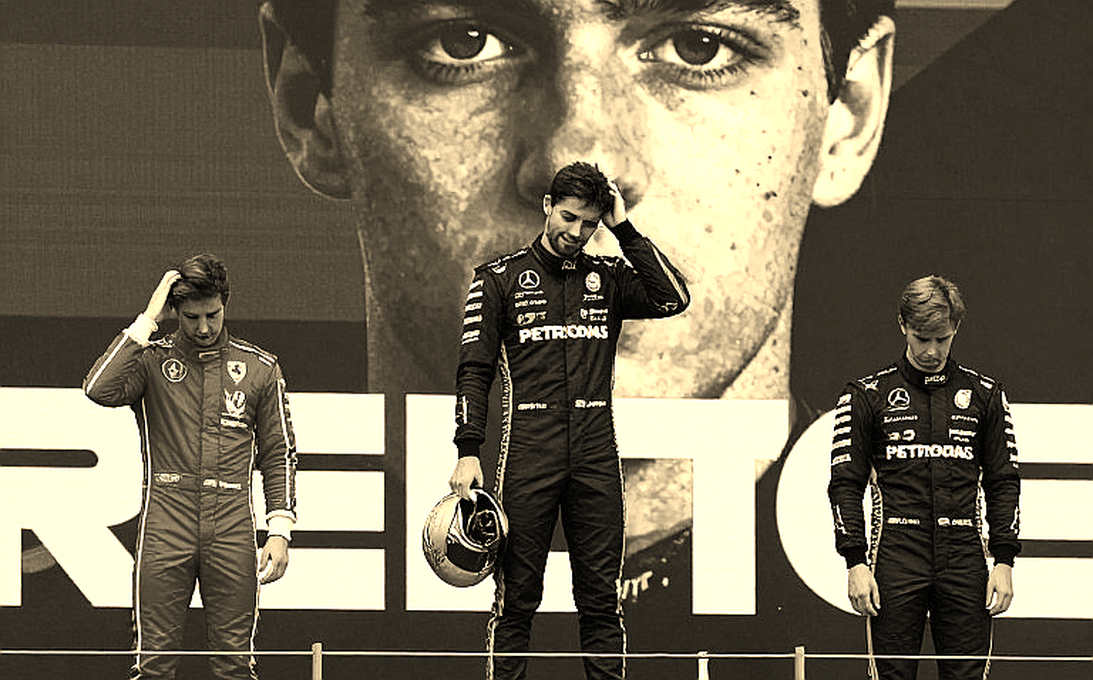
Twenty-year-old Italian driver Antonelli sealed his first Formula One World Championship at the Mexico City Grand Prix—and in doing so, he not only won the title but became the youngest F1 champion in history. Approximately 83 percent of the season's distance had been completed, four races remained, and this young driver's points gap was so large that he had already neutralized the maximum points swings of the remaining three race weekends.
This report presents a detailed analysis of that historic achievement—from the technical side to strategy, team dynamics, the competitive landscape, the regulatory framework, and the driver market. It is important to understand that available public information is limited, so where there are no solid facts, the analysis is clearly marked as inference. Transparency is the guiding principle of this report: what is known is presented as fact, and what is inference is presented as inference.
The Core Facts: What Happened, Where, and Why It Is Historic
Let us first clarify the core facts. Antonelli is twenty years old—the youngest age of any World Champion in F1 history. The previous record was set at twenty-three. This four-year gap is not trivial; it equals a full generation's interval. In any sport, when a record is broken by such a large margin, it means something that was previously stable has fundamentally changed.
Antonelli is Italian. This fact alone carries enormous commercial and cultural significance, because Italy's last World Champion came in 2026—followed by a drought of more than seven decades. An Italian driver becoming World Champion is a generational moment for Italian media, sponsors, and fans.
The title was sealed at the Mexico City Grand Prix. This venue is itself technically decisive. Mexico City sits at approximately 2,240 meters above sea level, where air density is roughly 78 percent of sea level. Thin air means less aerodynamic downforce, less drag, and a forced move to maximum cooling configurations. Pressure increases on turbochargers and energy recovery systems. A title clinched at altitude usually belongs to cars that are thermally and mechanically robust, not merely those with peak aerodynamic efficiency.
And fourth—clinching the title with four races remaining. Mathematically, this indicates that Antonelli's points gap was so large that even the maximum possible points swing in the remaining three race weekends could not change his position. That gap is usually equal to more than one race win, the result of strong and consistent performance rather than a single lucky outcome.
Historical Context: Why Age Twenty Matters
Formula One has always maintained a conservative assumption about age. The physical and mental demands of this sport are extraordinary—G-forces on the neck and body in every race, sustained high alertness, the ability to communicate technically with the team, and the speed of decision-making. Traditionally, it is believed that a driver peaks between the ages of 25 and 30.
Becoming World Champion at twenty means Antonelli crossed all these thresholds at once—and not only in speed but in maturity. The biggest challenge for a young driver is not raw pace; it is the ability to contribute meaningfully to the car's development direction. An experienced driver can tell engineers where the car is weak, what changes are needed in which corner, and how tire behavior changes. A twenty-year-old driver is still learning all this. Antonelli's title suggests that his technical feedback loop matured unusually quickly.
It should also be remembered that the youngest champion record is not merely an individual achievement. It is an achievement of the entire driver development system. Whichever team Antonelli is part of, its junior academy has produced a driver who could reach the summit at such a young age. This is proof of that team's talent identification and training capability.
Technical Analysis: The Question of Car and Power Unit
One thing must be made clear here first: there is no technical detail in the available information. No upgrade is named, no component, no design concept. Therefore, technical analysis can only be based on the shape that the title win has revealed.
As season-scale validation, winning a title with four races remaining is the strongest possible aggregate proof of a car's race pace, reliability, and tire-management envelope across roughly twenty rounds. A car must deliver consistently across different circuit types, different weather, and different tire strategies. Dominance at a single circuit does not produce a title with four races remaining. Therefore, it can be concluded with high confidence that this title reflects aggregate car capability.
But which technical mechanism produced that capability cannot be said from this information. Several possibilities exist that cannot be separated: Was it the power unit's superior energy management capability? Was it the chassis's better aerodynamic concept? Was it superiority in tire management? Was it a better cooling arrangement in altitude and high-temperature conditions? Any of these, or a combination, is possible—but there is no means of confirmation.
One important possibility is that if this title was won in the first season of a regulatory reset—which available context suggests—then the technical conclusion changes fundamentally. Titles won in the first year of new rules usually reflect power unit or concept-level advantage rather than incremental aerodynamic superiority. And historically, such advantages have not been as durable as they appear, because rivals quickly converge on the successful concept.
Another aspect that cannot be ignored: a gap that defeats the maximum possible points swing in the final three race weekends is usually based on reliability. If the car repeatedly retired with mechanical failures, clinching a title with four races remaining would be nearly impossible, because retirements directly lose points. In a twenty-round campaign, if the title was settled this early, it means mechanical failures were very few. However, this is an inference based on absence, not direct evidence—so it should be taken with low confidence.
The Mexico City Factor: The Technical Stress of Altitude
Understanding the Mexico City Grand Prix is essential to understanding this title. This circuit is one of the most unique and technically demanding venues on the calendar.
At 2,240 meters above sea level, air density drops. The first effect is reduced aerodynamic downforce—cars struggle to maintain grip in fast corners. The second effect is reduced drag, meaning higher speed on straights. The third and most important effect is that teams must move to maximum cooling configurations, because airflow is reduced in thin air and brakes and power units run hotter.
What does this mean? It means a car winning in Mexico must be strong in three things: thermal management, mechanical robustness, and power unit efficiency at high altitude. Teams that rely only on peak aerodynamic efficiency often underperform in Mexico. Teams that are strong overall balance the altitude challenge better.
In addition, Mexico City is one of the calendar's highest-variance strategic venues. Safety car deployments have historically been more frequent here. Long full-throttle runs and the propensity for tire graining make strategic decisions riskier. A title sealed at such a venue is often decided not by clean strategic brilliance but by risk management amid variance.
Race Strategy: What Information Is Missing, and What Follows
An honest admission is necessary here: there is no strategic information about the title race in the available information. No tire choice is mentioned, no pit window, no safety car intervention, no team orders. Only the outcome is stated—the title was sealed—without saying how it happened in the race.
This absence is significant because the title in Mexico could have been sealed in three structurally different ways: (a) by winning the race outright, (b) by finishing ahead of the sole remaining rival, or (c) by the rival failing to score. Each implies a completely different strategic story. But the information does not distinguish among them.
For this reason, it must be said: analysis of the title race's strategy is impossible due to insufficient information. What can be said at a general level is that when a title is sealed at 83 percent distance, the remaining races can neither validate nor invalidate it—the title was won in aggregate, not in a single decisive call.
A medium-confidence inference is that the decisive strategic work likely happened in the middle of the season, where the team converted a close fight into a large gap. Mexico merely applied the final seal. But this is inference, not confirmation.
Team and Driver: The Absence of the Teammate Is an Analytical Problem
The biggest gap in the available information emerges here: the team is not named, the teammate is not named, constructors' standings are not mentioned, and there is no information about the second car's performance.
This is a serious analytical problem, because in any credible title season, the intra-team comparison is the most informative benchmark. Same machinery, same strategy access, same team support—this is the only controlled situation in which the driver's contribution can be separated from the car's. Its total absence means the reader cannot distinguish the driver's and car's contributions.
Still, some conclusions can be drawn. Winning a title with four races remaining indicates a high level of consistency—a driver who repeatedly makes mistakes cannot reach such a large gap. Becoming champion at twenty is an exceptionally early arrival at the summit.
Another important point that cannot be ignored: winning the World Championship at twenty means this driver has instantly become the center of the team's sporting gravity. Regardless of who the team's existing lead driver is, a World Championship converts a "development project" into the team's sporting priority. This directly affects contract value, development-feedback priority, and pit-wall decision weighting.
For the fellow teammate, the situation has become precarious both commercially and sportingly. Being out-titled by a twenty-year-old teammate in the same season typically creates option pressure within one contract cycle. However, this is inference—the teammate is not known.
Discipline and Maturity: The Psychological Side of a Twenty-Year-Old Champion
Becoming World Champion at twenty is not only a technical or physical achievement. It is also a psychological one. Pressure in Formula One is extraordinary—media, team, sponsor, and rival pressure in every race weekend. For a young driver, handling this pressure and delivering at the top consistently is unusual.
There is no data in the available information on wet-weather conditions, pressure moments, or error rates. Therefore, psychological profile analysis is impossible due to insufficient information. But one conclusion can be drawn: winning a title with four races remaining requires a season-long level of mental stability. If the driver repeatedly collapsed under pressure, this gap would not be possible. This is "negative evidence"—meaning there is no reported failure—whose diagnostic value is limited, but it cannot be entirely ignored.
The Competitive Landscape: A Signal of Regime Change
Antonelli's victory should not be viewed merely as an individual achievement. It is a signal of regime change—a major reshuffling of Formula One's competitive order.
When the youngest champion in history takes the crown with four races remaining, it means the competitive order has not seen a marginal shift but a fundamental reshuffling. The old reference points of "who leads the paddock" are now outdated.
An important historical pattern must be understood here. Regulatory resets—especially new power unit and chassis rules—systematically reward organizations with integrated power unit capability. Historically, the first season of a formula change has disproportionately favored manufacturer-backed works operations, because the performance differentiator moves upstream from aerodynamics to energy management.
But there is also a warning that must not be ignored: first-year dominance is a weak predictor of sustained dominance. The historical rate of first-season-of-new-rules champions converting into multi-year dynasties is roughly one in three; the more common outcome is that rivals converge on the successful concept and the gap shrinks.
Another point that is mathematically clear: a title decided this early rules out a close multi-team fight. This means at least two previously dominant competitive forces were displaced—meaning the incumbent benchmark organizations failed to adapt to the new formula.
The midfield is entirely invisible here. No other team is named in the information, so comparisons of points density, ATR effect, or tier mobility cannot be made. Insufficient information, cannot assess.
Rules and Governance: The Need for Quiet Caution
This is the most sensitive part of this report. There is no regulatory content in the available information—no stewarding decision, no penalty, no technical directive, no compliance matter. For this reason, insufficient information, cannot assess.
But the structural risk is real and should be flagged. The first season of a new power unit formula in any cycle carries the highest probability of interpretation disputes, because the rules text has not yet been pressure-tested by competitor protest. In this state, successful teams often exploit grey-area interpretations, which can later become a source of controversy.
An important structural fact is that technical and financial compliance questions in F1 are usually resolved after the season. Therefore, an early title provides no reassurance about the champion's eventual regulatory standing. Cost cap audits are published roughly a season in arrears, and their outcome may emerge in the period after the title.
Another subtle point: teams that win in the first season of a new formula see their technical staff gain disproportionately high credibility in shaping future rule amendments. This is a signal of a "governance game"—the title benefits not only on track but also at the rule-making table. However, the magnitude of this benefit is unknown.
The Driver Market: The Seismic Impact of a Twenty-Year-Old Champion
From a driver market perspective, Antonelli's victory is structurally disruptive. A twenty-year-old champion redefines the entire pricing and options landscape.
In sporting value terms, this is the strongest signal available in the market—the youngest champion in history, with four races remaining. Commercial value is also structurally elevated. Italian nationality has its own multiplier, because the Italian market has been without a home World Champion for more than seven decades. The wait has continued since 2026. This means there is a built-up demand in the national sponsor and media market that will reprice this driver's promotional value well beyond normal champion inflation.
An interesting economic aspect is that a young champion typically sits below the veteran pay ceiling for one contract cycle while delivering at the ceiling's performance level. This is a significant cost-effective advantage, if driver salaries remain outside the cost cap—which they do under current Financial Regulations.
A single cascading trigger in the seat landscape is now defined. A newly crowned twenty-year-old champion creates a vacuum effect: every team with an open seat must first ask whether a competitive offer is possible, and every team with a locked seat must re-value its existing drivers against the new benchmark.
But honesty is again required here: beyond this, the seat landscape is entirely unanalysable. No other team or driver is named in the information. Insufficient information, cannot assess.
Commercial and Strategic Implications: Not Just a Title, a New Market
Antonelli's title will have commercial effects on several levels. First, sponsorship. An Italian World Champion is a unique opportunity for brands in the Italian market. For Italian brands like Ferrari, the rise of an Italian champion becomes a matter of national pride. Second, media rights. For Italian broadcasters, a domestic champion means increased viewer interest and higher advertising rates.
Third, the team's brand position. Whichever team made Antonelli a champion is now part of a new story—"The team that produced the youngest champion in history." This story is extremely valuable for marketing.
Fourth, the driver contract. A twenty-year-old champion now has a decisive advantage in negotiations. It is likely that he will lean toward a short-cycle renewal rather than a long-term one, because a twenty-year-old champion will rationally want to keep options open before the next regulatory inflection.
Risk Profile: What Challenges Follow the Title
Winning a title is the end of one story, not the beginning of another. Antonelli and his team face several structural risks that should be understood systematically.
Sporting risk—concentration: The title may be based on an unusually large gap that could compress next season. If the gap came mainly from a superior car concept, it could shrink as rivals converge. Monitoring early-season pace deltas is essential.
Sporting risk—rival convergence: Rivals converging on the successful concept during the winter is a high-probability risk. Historically, the gap narrows in the year after the first season of new rules. Tracking pre-season long-run pace is essential.
Technical risk—first-year power unit formula: In the first season of a new power unit formula, both reliability and interpretation risks are structurally elevated. Component usage and technical directive activity must be watched.
Technical risk—concept lock-in: A rule-optimal concept chosen now becomes difficult to abandon later. If the concept direction turns out to be wrong, a mid-cycle change will be expensive.
Personnel risk—talent poaching: Championship success often triggers the poaching of key engineering staff. Monitoring technical department movements and gardening leave is essential.
Personnel risk—internal hierarchy friction: Friction can arise in the internal hierarchy between the young champion and the existing lead driver. The tone of team radio and post-race messages must be watched.
Regulatory/financial risk—cost cap audit: Financial-regulatory risk is unknown but not negligible for any team winning under a cost cap. Audits are published roughly a season in arrears. No external mitigation is available; only audit publications can be watched.
Regulatory/financial risk—grey-area interpretation: A technical directive closing an already-exploited grey-area interpretation could affect performance. However, the impact is usually moderated by the team's prior lead.
Conclusion: The Beginning of an Era or a One-Season Miracle?
The final question is this: is Antonelli's title the beginning of a new era, or the result of an extraordinary season? The available information is not sufficient to give a definitive answer. But some things are clear.
First, becoming World Champion at twenty is a historic achievement that in itself sows the seeds of a new era. A record broken by a four-year margin shows that Antonelli's talent is above the normal scale.
Second, winning the title with four races remaining shows that this victory belongs not only to talent but also to a strong team and car. No single driver, no matter how talented, can win a title with four races remaining with an unreliable car.
Third, this title is a signal of regime change. The competitive order has changed. The old answers to "who is on top" are now outdated.
Fourth, and most importantly—this title leaves many questions unanswered. What was the technical basis of the car? How much was the driver's contribution relative to the teammate? Is this year-one advantage sustainable? Does any regulatory uncertainty remain? None of these can be answered from the available information.
And perhaps this is the beauty of Formula One. Every title is the end of one story and the beginning of a new one. Antonelli's story has just begun. Becoming World Champion at twenty is an achievement, but it is only the first chapter. The next chapters—whether he can maintain this summit, whether he can build a multi-title dynasty, whether rivals can catch him—time will tell.
What is certain is this: on that evening in Mexico City, a new page was added to Formula One's history. And on that page is written—Antonelli, twenty years old, World Champion. The youngest. The first. And perhaps, the furthest ahead.
Summary: Key Points
- Twenty-year-old Italian driver Antonelli sealed his first F1 World Championship at the Mexico City Grand Prix with four races remaining.
- He became the youngest F1 World Champion in history; the previous record was twenty-three—a four-year gap.
- Sealing the title at roughly 83 percent of the season's distance signals aggregate car capability, reliability, and consistency.
- The 2,240-meter altitude of Mexico City demands thermal and mechanical robustness—favoring cars that are strong overall.
- Team name, teammate, and technical details are unavailable—so a precise analysis of driver vs. car contribution is impossible.
- This title signals regime change in the competitive order; old benchmarks are outdated.
- The twenty-year-old champion has established a cascading trigger in the driver market; commercial value in the Italian market is exceptionally high.
- Post-title risks: rival convergence, concept lock-in, talent poaching, and the inherent uncertainty of first-year rules.
- This could be the beginning of an era or a one-season miracle—but the available information is not sufficient to give a definitive answer to this question.